ellliottt

design & illustration

Menu

Skip to content
  • HOME
  • ABOUT
  • GRAPHIC
    • ALL GRAPHIC DESIGN
    • AUTOMOTIVUS
    • REBRAND: SPFL
      • Premiership
        • Aberdeen
        • Celtic
        • Dundee United
        • Heart of Midlothian
        • Hibernian
        • Kilmarnock
        • Livingston
        • Motherwell
        • Rangers
        • Ross County
        • St Johnstone
        • St Mirren
      • Championship
        • Arbroath
        • Ayr United
        • Cove Rangers
        • Dundee
        • Greenock Morton
        • Hamilton Academical
        • Inverness CT
        • Partick Thistle
        • Queen’s Park
        • Raith Rovers
      • League One
        • Airdrieonians
        • Alloa Athletic
        • Clyde
        • Dunfermline Athletic
        • FC Edinburgh
        • Falkirk
        • Kelty Hearts
        • Montrose
        • Peterhead
        • Queen of the South
      • League Two
        • Albion Rovers
        • Annan Athletic
        • Bonnyrigg Rose
        • Dumbarton
        • East Fife
        • Elgin City
        • Forfar Athletic
        • Stenhousemuir
        • Stirling Albion
        • Stranraer
    • REBRAND: SHFL
      • Brechin City
      • Brora Rangers
      • Buckie Thistle
      • Clachnacuddin
      • Deveronvale
      • Formartine United
      • Forres Mechanics
      • Fraserburgh
      • Huntly
      • Inverurie Loco Works
      • Keith
      • Lossiemouth
      • Nairn County
      • Rothes
      • Strathspey Thistle
      • Turriff United
      • Wick Academy
    • REBRAND: SLFL
      • Berwick Rangers
      • Bo’ness United
      • Broomhill
      • Caledonian Braves
      • Civil Service Strollers
      • Cowdenbeath
      • Cumbernauld Colts
      • Dalbeattie Star
      • East Kilbride
      • East Stirlingshire
      • Edinburgh University
      • Gala Fairydean Rovers
      • Gretna 2008
      • Spartans
      • Tranent Juniors
      • University of Stirling
  • 2D
  • 3D
    • ALL 3D
    • INSTALLATION
  • PHOTO
  • SHOP

badge

ReBrand: Heart of Midlothian FC

graphic

HMFC badge new-01The precise origin of the Heart of Midlothian Football Club is unclear. A report in The Scotsman from 1864 first mentions ‘Heart of Midlothian’ as a cricket club, though it is not known for certain whether—alongside the likes of Kilmarnock, St Johnstone, Dunfermline Athletic and St Mirren—this cricket club would eventually form the football club of the same name. What is known is that Heart of Midlothian adopted association football rules in 1874, which is considered the official year of the club’s formation.

In 2013, this illustrious club, bearing such domestic honours as four top tier (tied for third most), eight Scottish Cups (fourth most) and four Scottish League Cups (fourth most), began process of entering into administration. This resulted in disciplinary action by the Scottish Football Association, including an embargo on signing new players. Hearts were also forced to begin the 2013/14 season with a fifteen-point deduction.

By the end of the season, Hearts found themselves at the bottom of the top tier table and were relegated to the Scottish Championship (all other things being equal, had they not been deducted the 15 points, they still would have ended the season in a relegation playoff position). But demonstrating profound resilience, Hearts were able to secure promotion to the Scottish Premiership with seven games remaining in the 2014/15 season. With the events of the COVID-19 pandemic, resulting in the wrapping up of the 2019/20 season after 30 matches, Hearts found themselves relegated back to the Scottish Championship for the 2020/21 season. Their stay wouldn’t last long, as Hearts topped the table for a return to the Premiership for the 2021/22 season.

As far as badges go, the current Hearts badge is very strong. The image is based on a mosaic that can be found on the pavement near St Giles Cathedral on the Royal Mile in Edinburgh. The mosaic sits on the site of the Old Tolbooth (which stood between c.1400 and 1817), the former administrative centre of Edinburgh as well as the site of a prison and public executions.

With my redesign, I wanted to call back to an earlier age without doing away with the current badge completely, borrowing some features from the club’s previous badges, namely, the vertical bars supporting a central heart. I incorporated the more obtuse heart and gold lettering found in the current badge. I also incorporated a subtle Saltire in the inner and outer rings.

HMFC badge-01

For both the home and away kits, I went with a pared-down, 1970s look.

HMFC kit-01

HMFC badge new-01

As ever, I am indebted to Dave at Historical Football Kits for some of the historical information used above.
24 April 20189 June 2021 E Tagged badge, crest, Edinburgh, Europe, football, Heart of Midlothian, Heart of Midlothian FC, Heart of Midlothian Football Club, Hearts, Hearts FC, Hearts Football Club, HMFC, Jam Tarts, Jambos, logo, rebrand, redesign, Scotland, Scottish Premiership, Scottish Professional Football League, SPFL, SPFL Premiership, SPFL Scottish Premiership, sport, texture, The Jam Tarts, The Jambos, UK, United Kingdom 1 Comment

ReBrand: Hamilton Academical FC

graphic

HAFC badge new-01Hamilton Academical Football Club was established in 1874 by, as the name suggests, pupils and the rector of Hamilton Academy (1588-1972).
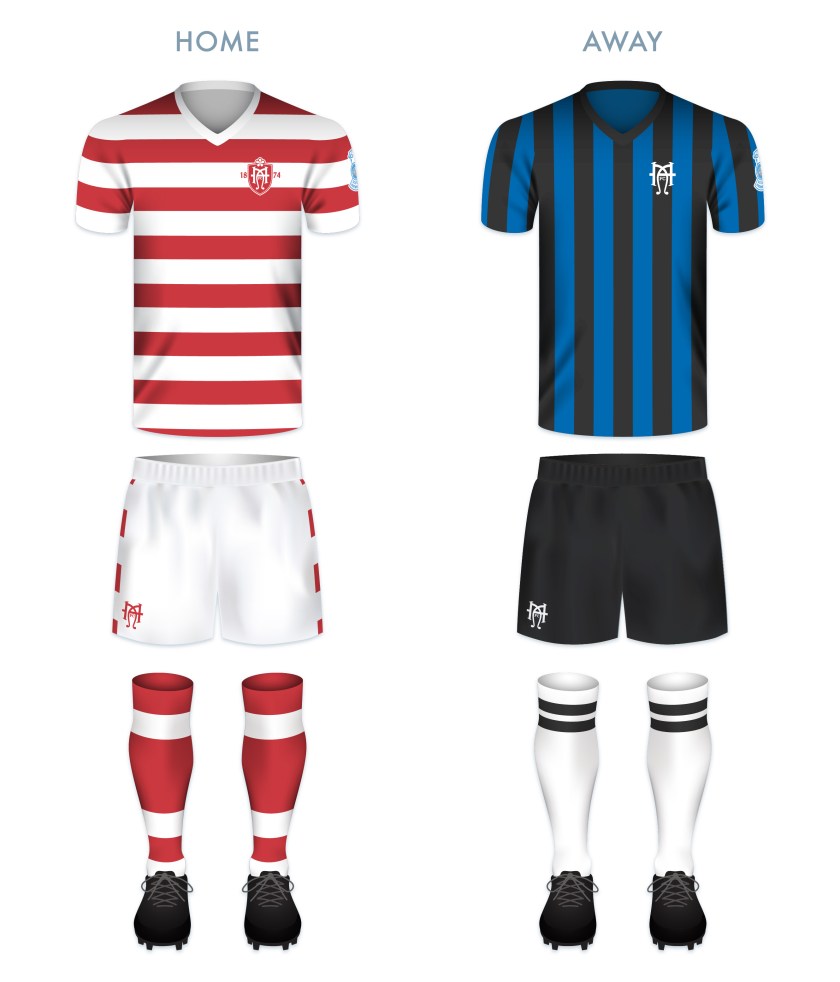
Although the academy’s colours were blue and green, the Accies played in red and white so as to distinguish themselves from the earlier Hamilton Football Club (which folded in 1878).

The Accies competed as founding members of the Lanarkshire Football League from 1893 until, following the resignation of Renton Football Club (1872-1922) in 1897, they were elected to the third division of the Scottish Football League. Since that time, the Accies have reached two Scottish Cup finals (1910/11 and 1934/35), though their spells in the top flight have been mixed. Their best ever top tier performance came in the 1934/35 season, when the Accies finished in fourth place with 48 points, behind Hearts (50), Celtic (52) and Rangers (55).

More recently, at the end of the 2013/14 season, the Accies gained promotion from the Scottish Championship to the Scottish Premiership, joining Dundee in the top tier for the 2014/15 season. Because of 2013’s launch of the Scottish Professional Football League and the restructuring of the Scottish league system, the Accies, who came in just behind Dundee in the Scottish Championship, had another opportunity for promotion by competing in several playoff rounds. There, they faced the Scottish Premiership‘s Hibernian in the second leg of their playoff schedule, playing away at Easter Road with a 0-2 deficit for which they had to make up in order to gain promotion. The Accies performed brilliantly, leading 1-0 at half time and adding a second goal in the 90th minute. After extra time, the score remained 2-0, leaving an aggregate score of 2-2 over two matches, forcing a penalty shootout. In the end, the Hamiltonians were victorious, sending Hibs down to the Scottish Championship and gaining promotion to the top tier for yet another shot at the top tier since their consecutive promotions and relegations in 2008 and 2011, respectively. The Accies’ stay in the top tier would last until the end of the 2020/21 season, when the club finished at the bottom of the table and were relegated to the Scottish Championship.

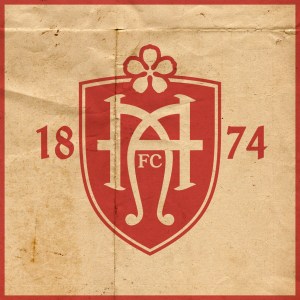
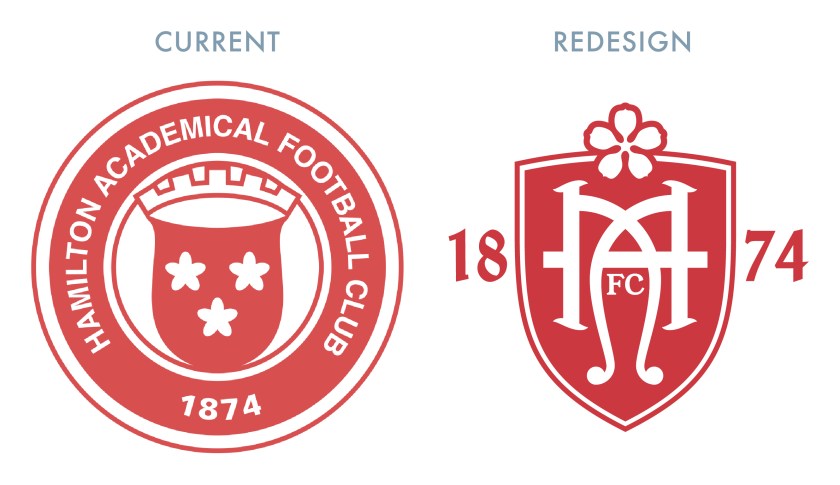
The Hamilton Academical kit did not feature a badge until 1979, when the current badge was introduced. This badge features a shield with three white cinquefoils derived from the Clan Hamilton coat of arms. The shield is encircled by a ring with the club’s name and founding date. For my redesign, I’ve drawn heavily from the original crest of Hamilton Academy, creating a minimalist ‘HA’ monogram within a shield, topped with a singular white cinquefoil.

HAFC badge-01

I went with the Accies’ classic red and white hoops (used for most home shirts from at least 1876) for the home top and a historical and [an unintentional, though admittedly Inter Milan-esque] black and blue-striped away top. The away strip and both pairs of shorts feature the ‘HA’ monogram alone.

HAFC kit-01

HAFC badge new-01.jpg

As ever, I am indebted to Dave at Historical Football Kits for some of the historical information used above.

23 April 20189 June 2021 E Tagged Accies, badge, crest, Europe, football, Hamilton, Hamilton Academical, Hamilton Academical FC, Hamilton Academical Football Club, Hamilton Academy, Lanarkshire, logo, monogram, rebrand, redesign, Scotland, Scottish Championship, Scottish Professional Football League, South Lanarkshire, SPFL, SPFL Championship, SPFL Premiership, sport, texture, The Accies, UK, United Kingdom Leave a comment

ReBrand: Dundee FC

graphic

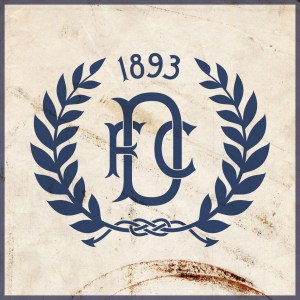
DFC badge new-01Established in 1893 by way of a merger between two Dundee football clubs—East End and Our Boys (both formed in 1877)—throughout the club’s history, Dundee Football Club have experienced their fair share of glory. The club won the Scottish Cup in 1909/10, as well as the Scottish League Cup in 1951/52, 1952/53 and 1973/74. The Dee were also crowned 1961/62 Scottish champions and the following season, they reached the semi-final of the European Cup.

But in 2003, Dundee’s future was put in jeopardy. As a result of accruing a £23m debt, the club was placed in administration. The Dee was able to continue operations after selling their stadium and remained in the second tier until 2012, when they gained unexpected promotion into what was then the Scottish Premier League as a result of the financial collapse of Rangers. Unfortunately, Dundee was knocked back down to the second tier after just one season.

Demonstrating their resilience, Dundee fought successfully to win the 2013/14 Scottish Championship (the second tier in Scottish football after the 2013 founding of the Scottish Professional Football League), beating out Hamilton Academical for the title and gaining promotion back to the top tier. Dundee’s fortunes took another knock at the end of the 2018/19 season, when they finished at the bottom of the Premiership table and were relegated to the Championship once again.

In Dundee’s first season back in the Championship, they finished third, but upon the second asking, came in second behind Hearts, earning themselves a place in the Premiership play-off semi-final against Raith Rovers. Having dispatched the Rovers 3-1 over two legs, Dundee went on to face Premiership side Kilmarnock in the final. Dundee were able to hold on, defeating Killie 4-2 over two legs and joining their city rivals Dundee United in the top tier for the 2021/22 season.

In 1952, the Dee first began sporting a club badge on their tops, featuring ‘DFC’ laid out diagonally, enclosed in shield. In 1955, the club began using the current ‘DFC’ badge. By 1970, a new badge, replacing the shield with a circle and red detail, was used on the kit. 1973 saw the return of the ‘DFC’ monogram, though without a shield. This was used until 1987, when a new badge (a variation of the design that appeared after the Second World War on official blazers and publications) was adopted. In 2008, Dundee returned to their original 1955 badge.

While I have long admired the 1955 badge, for my redesign I wanted to draw out more of the club’s history and locale. I drew inspiration from the laurel wreath featured in the badge used from 1987 to 2008 (which has reappeared for the 2019/20 season), as well as the knotted dragons’ tails in the Dundee coat of arms. I also redesigned the lettering of the monogram to be more uniform and proportioned and have added some implied depth by interweaving the letters. In seeking to comply with the ancient Scottish heraldic law forbidding lettering within a shield which is not approved by the Court of the Lord Lyon (something against which clubs like Airdrieonians and Ayr United have struggled), I have omitted the handsome shield surrounding the monogram.

DFC badge-01 2

The home shirt makes use of the traditional Dundee FC colour scheme of dark blue, red and white in a striking geometric arrangement. The away kit is inspired by the 1971/72 home kit and various away kits over the years, most recently, the away kit used for the 2016/17 season.

DFC kit-01

DFC badge new-01

As ever, I am indebted to Dave at Historical Football Kits for some of the historical information used above.

23 April 20189 June 2021 E Tagged badge, crest, Dark Blues, Dee, Dees, DFC, Dundee, Dundee City, Dundee FC, Dundee Football Club, East End, East End FC, East End Football Club, Europe, football, logo, monogram, Our Boys, Our Boys FC, Our Boys Football Club, rebrand, redesign, Scotland, Scottish Premiership, Scottish Professional Football League, SPFL, SPFL Premiership, SPFL Scottish Premiership, sport, texture, The Dark Blues, The Dee, The Dees, UK Leave a comment

ReBrand: Celtic FC

graphic

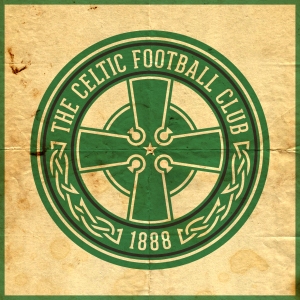
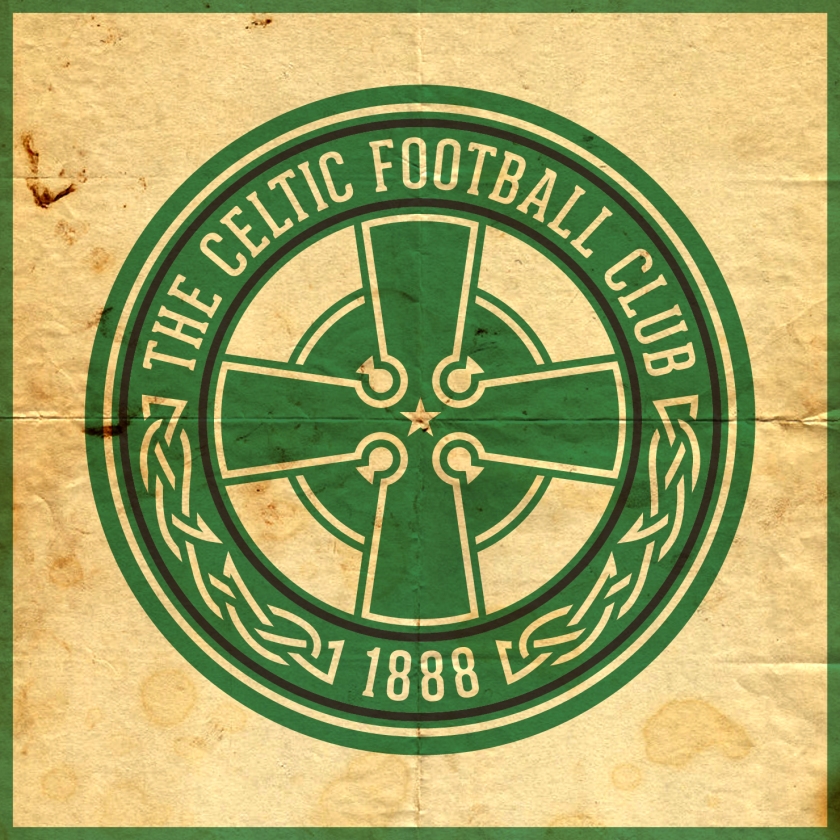
CFC badge new-01This whole ReBrand project was first inspired by my toying around with the iconic Celtic badge over over many years. Established in 1888, Celtic has become one of the most adorned and respected football clubs in the world. As of the end of the 2018/19 season, their honours include being crowned Scottish champions on 50 occasions, 39 Scottish Cups and 18 Scottish League Cups.

Celtic’s most successful season came in 1966/67, when the club participated in five competitions (the Scottish First Division, the Scottish Cup, the Scottish League Cup, the Glasgow Cup and the European Cup), winning each one. Their 2-1 European Cup victory over Inter Milan made Celtic the first British and only Scottish club to have achieved the honour. In addition to these highlights, for three consecutive seasons (2016/17, 2017/18 and 2018/19), Celtic have won every domestic trophy on offer (nine), completing the first Scottish ‘treble-treble’ (no other Scottish side has even won the domestic treble in two consecutive seasons).

Redesigning the badge of such an iconic football club (with some of the most devoted supporters in the world) was a daunting task, even if my alterations were only for fun.

The beginning of Celtic can be dated from a meeting held in the hall of St Mary’s Catholic Church in the Calton district of Glasgow. The meeting was led by Marist Brother Walfrid (born Andrew Kerins in Ballymote, Ireland), who proposed that a football club be established to raise funds for the alleviation of the rampant poverty in Glasgow’s East End, similar to the mission of Edinburgh’s Hibernian Football Club when it was established in 1875. In fact, on 28 May 1888, when Celtic played their first match (a 5-2 victory over Rangers at Glasgow Green), many of the side’s players were borrowed from Hibernian.

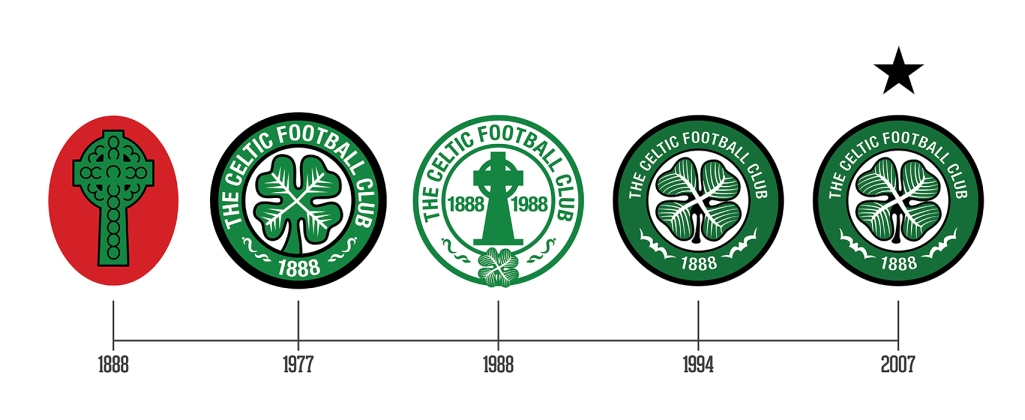
Celtic’s original strip featured a green Celtic cross within a red oval. In 1889 they adopted vertical green and white stripes for their home shirt, without a badge. The vertical stripes were replaced by their now-famous hoops in 1903. During the first half of the twentieth century, the club’s home strip lacked a badge, but their away tops featured a large three-leafed shamrock from time to time between 1925 and 1965. Celtic’s shirts did not feature a regular badge until 1977 (based on a badge that first appeared on the cover of their 50th [Golden] Jubilee Dinner menu in 1938), upon which most of their subsequent badges have been based. In 1988, the club celebrated their centenary with a badge derived from the Celtic cross of their very first badge. The following season they reverted back to their 1977 badge.

In 1994, the badge was updated very slightly and this design remained unaltered until the 2007/08 season, when Celtic celebrated the 40th anniversary of their European Cup victory with the addition of a star.

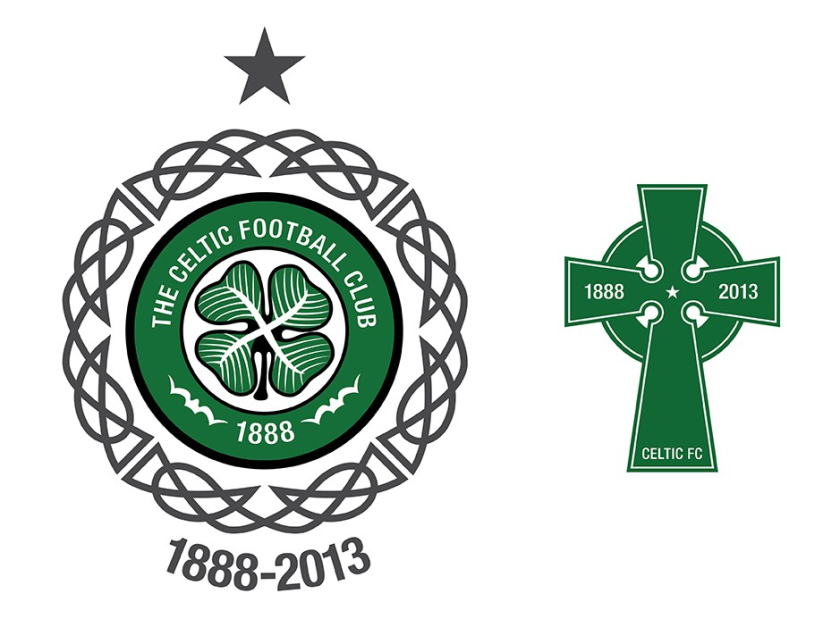
Badge historyAfter the 2007/08 season, the star was retained and the badge remained the same until 2012/13 season, when Celtic celebrated their 125th anniversary by using a 1994 badge encircled by an attractive Celtic knot and an alternative badge featuring a Celtic cross.
125th-badges-sm.jpg

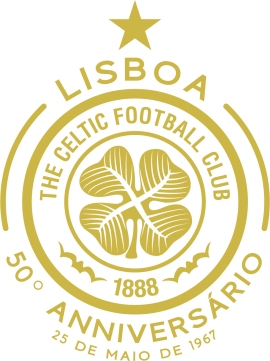
For the 2017/18 season, Celtic utilised the badge below, commemorating 50 years since their historic European Cup victory:

50th anniversary

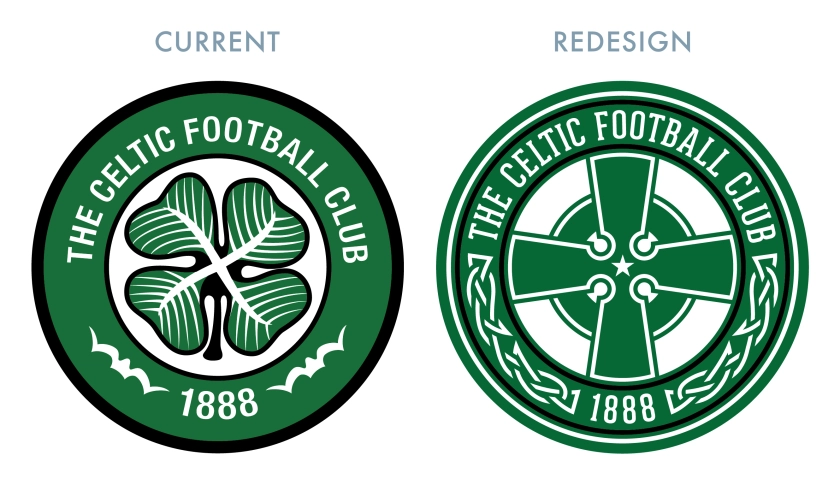
I found the cross and the knot from the 2012/13 badges too attractive to disregard entirely. For my redesign, I have incorporated both (with the Celtic cross calling back to the original 1888 badge and the 1988 centenary badge). In addition to the Celtic knot and cross, I changed and centred the typeface.

CFC badge-01 2

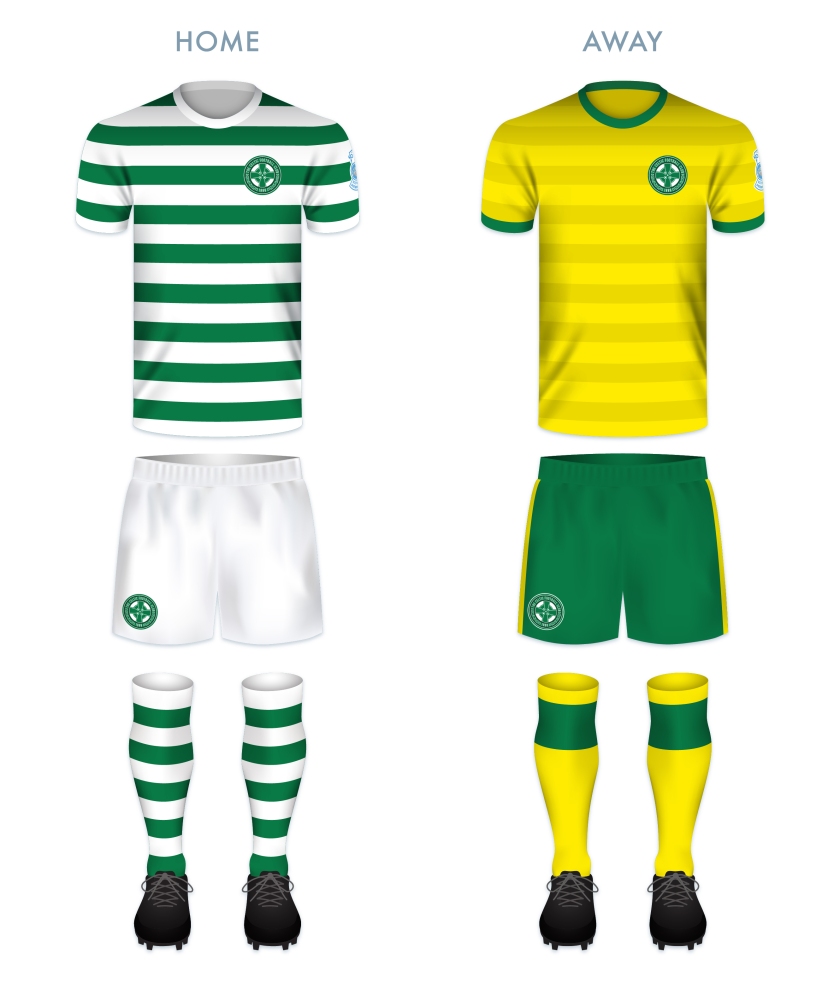
For the home shirt, to depart from the classic hoops would be anathema. I am a particular fan of the narrow hoops, which saw recent use in the 2012/13 shirt. The away kit colour scheme is taken from many historical Celtic away kits dating from 1973.

CFC kit-01

CFC badge new-01

As ever, I am indebted to Dave at Historical Football Kits for some of the historical information used above.

23 April 201824 February 2020 E Tagged badge, Bhoys, brand, Celtic, Celtic cross, Celtic FC, Celtic Football Club, Celtic knot, Celts, crest, cross, Europe, European Cup, football, Glasgow, Glasgow Celtic, history, hoops, Ladbrokes Premiership, Lisbon Lions, logo, rebrand, redesign, Scotland, Scottish Premiership, Scottish Professional Football League, SP, SPFL, SPFL Premiership, sport, star, texture, The Bhoys, The Celts, The Hoops, UK, United Kingdom 4 Comments

ReBrand: Íslenska karlalandsliðið í knattspyrnu

graphic

It’s been a long while since my last ReBrand post. Being that we’re in the latter stages of the 2016 Euros, I thought that I ought to branch out of the SFA (at least for this one design) and venture into the world of international football. And what better side to celebrate than those wonderful underdogs, Íslenska karlalandsliðið í knattspyrnu, or, to us non-Íslendingar, the Iceland national football team. Iceland’s top football division, Úrvalsdeild, was established in 1912, though their first international match did not take place until 29 July 1930, when Iceland won 1-0 at the Faroe Islands. The Football Association of Iceland (Knattspyrnusamband Íslands, or KSÍ), and in turn, Iceland’s FIFA membership, was not established until 1947.

This year’s Euros were Iceland’s first major tournament appearance. And whilst they are most definitely the smallest nation to have ever qualified for a major tournament (with a population of some 334,000), Iceland has inspired many viewers (and perhaps especially many of us in Scotland, who did not qualify for the tournament) with their surprising results. They opened up the group stage with 1-1 draws against Portugal and Hungary, before sealing their place in the Round of 16 with a 2-1 victory over Austria. Most shockingly, Iceland produced a stunning display against England (another 2-1 victory), advancing to the Quarter-finals. Their run was ended on 3 July by tournament hosts France (5-2).

Iceland’s spirit remains inspirational — sharing a 10,000+ person ritual (the now-famous ‘Viking clap’) upon their return home.

One thing that struck me about Iceland from the very start was the state of their kit, the KSÍ badge being perhaps the most distracting element for someone of my depraved disposition.

I have been impressed by Matthew Wolff, designer with New York City FC, who already had the idea to redesign the Iceland badge, basing it on a previous incarnation. Wolff’s design features a semi-runic styled KSÍ, flanked by two halves of a football, all set in front of an iceberg. He even pitched the idea to the KSÍ. Whilst Wolff’s design is striking, I’m not quite sure that an iceberg is representative of the whole of Iceland (with most of its sea ice originating from other places).

Coming up with [what I consider to be] a decent and somewhat meaningful rebrand for the KSÍ has been quite challenging, in part due to the fact that ancient Iceland produced a large number of compelling norse designs, such as Ægishjálmr (the Helm of Awe). But below I have settled on something perhaps more simplified.

KSÍ old

KSÍ final

6 July 20163 August 2017 E Tagged 2016 UEFA European Championship, Íslenska karlalandsliðið í knattspyrnu, badge, branding, Euro 2016, Europe, Euros, football, Football Association of Iceland, France, Iceland, Iceland national football team, island, Knattspyrnusamband Íslands, KSÍ, logo, Matthew Wolff, rebrand, sport, UEFA, UEFA Euro 2016 Leave a comment

ReBrand: Partick Thistle FC Update

graphic

Back in May 2013, I tried my hand at redesigning the Partick Thistle Football Club badge. I wrote,

‘I actually think the current crest is very strong, but I experimented with trying to tie a bit more history into it. Being that Partick Thistle has actually played in Maryhill (as opposed to Partick) since 1909, I wanted to find a way to acknowledge their mixed history by blending elements of both the Partick and Maryhill coats of arms in order to form the crest centrepiece. But that design proved too busy (it might be able to be retooled later). So for Partick Thistle I simply changed the typeface and added a few rings to frame the crest better…’

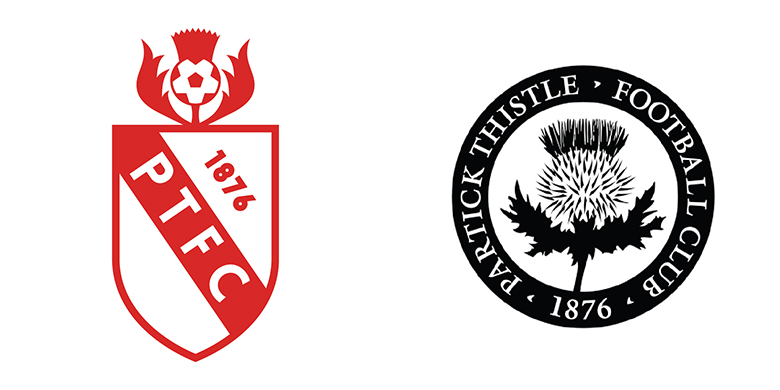
Truth be told, I was never content with the redesign because it wasn’t much a redesign at all. So I revisited the badge (something I hope to do with some other Scottish Premiership badges in the near future) and came up with something very different:

Partick Thistle FC oldI decided to add a more stylised thistle atop a traditional shield. It’s something like a throwback to 1970s style and I find it different enough to satisfy me.

Partick Thistle FC final

18 November 20143 August 2017 E Tagged association football, badge, crest, Europe, football, Glasgow, logo, Maryhill, Partick, Partick Thistle, Partick Thistle FC, Partick Thistle Football Club, rebrand, redesign, Scotland, Scottish Football Association, Scottish Premiership, Scottish Professional Football League, SFA, SP, SPFL, sport, UK, United Kingdom Leave a comment

Swim Team

graphic

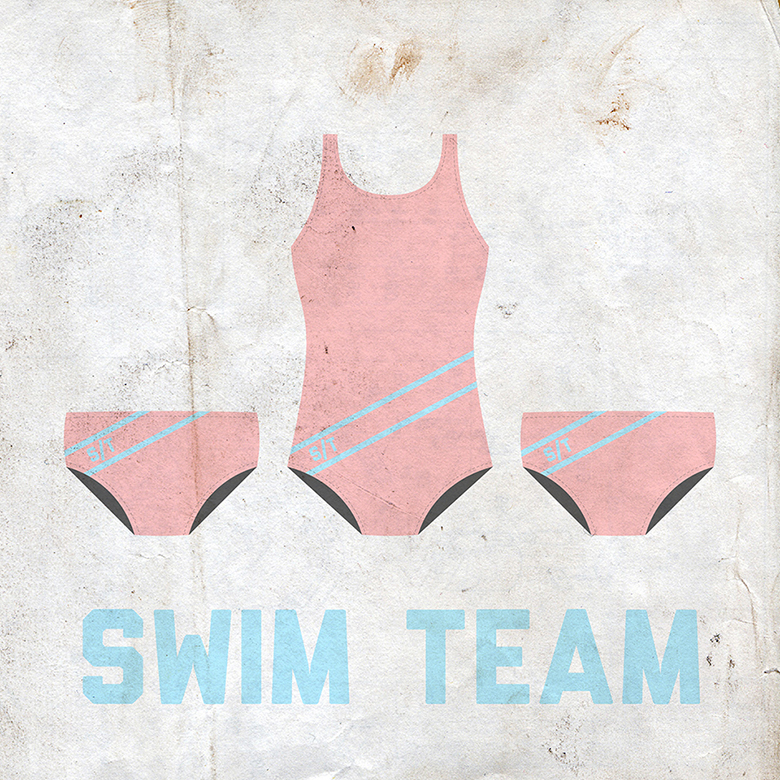
SWIM TEAM BADGE SWIMMING COSTUMES WAVES

Facebook | Twitter

30 January 201428 May 2014 E Tagged badge, band, branding, Glasgow, logo, Matt Regan, music, Swim Team, texture, theatre Leave a comment

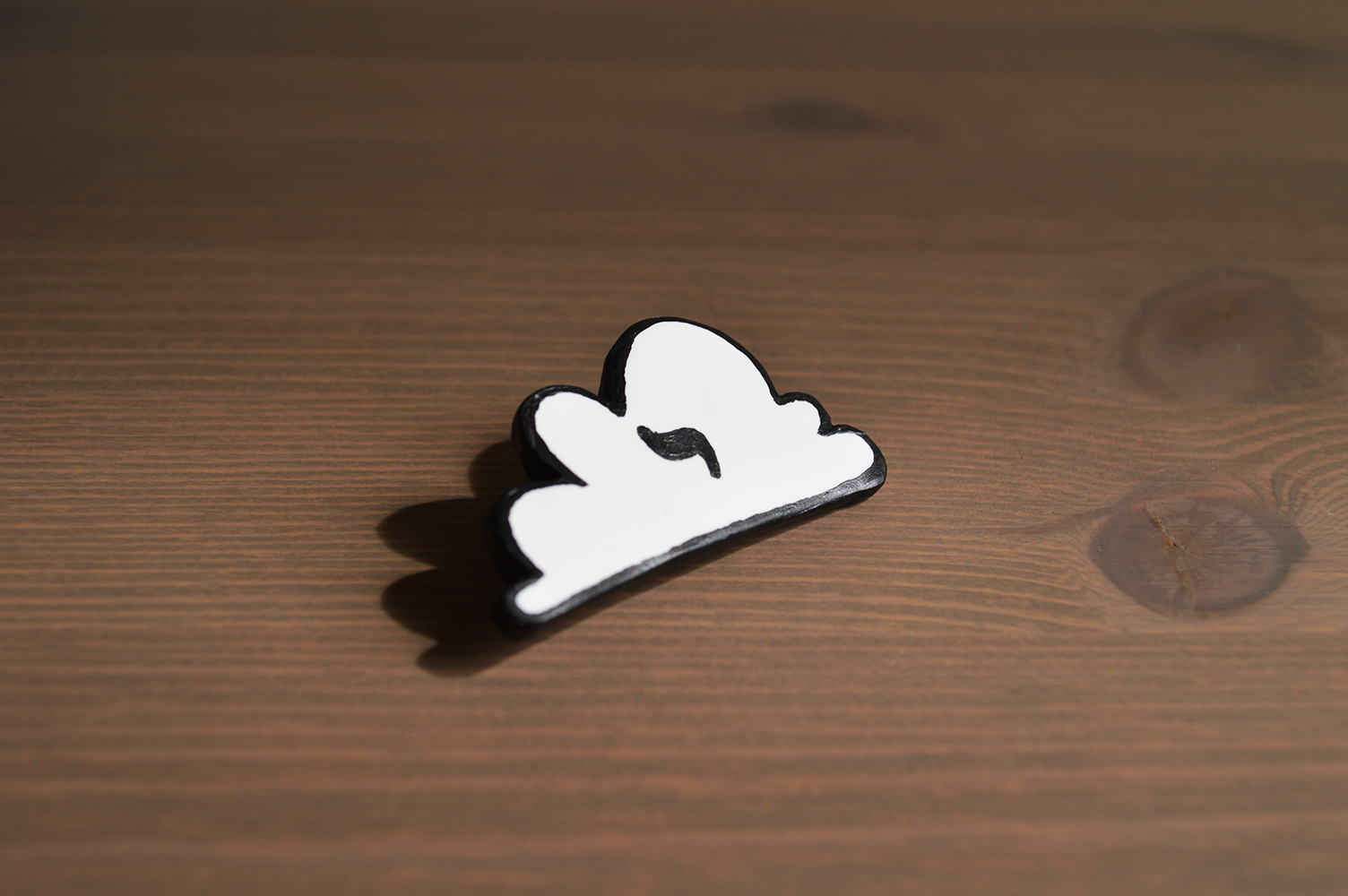
Yod (י) cloud badge

2D, 3D

Yod Cloud Badge 01Yod Cloud Badge 02
polymer clay, acrylic paint, 2.5 cm x 5 cm x .3 cm, 2013

20 April 201328 May 2014 E Tagged accessories, accessory, badge, cloud, fashion, fashion accessory, God, insignia, Lost in the Cloud, religion, Yod cloud, י Leave a comment

Posts navigation

Next →
Widgets
Create a website or blog at WordPress.com
Privacy & Cookies: This site uses cookies. By continuing to use this website, you agree to their use.
To find out more, including how to control cookies, see here: Cookie Policy
  • Subscribe Subscribed
    • ellliottt
    • Join 53 other subscribers
    • Already have a WordPress.com account? Log in now.
    • ellliottt
    • Subscribe Subscribed
    • Sign up
    • Log in
    • Report this content
    • View site in Reader
    • Manage subscriptions
    • Collapse this bar
 

Loading Comments...