
 Greenock Morton Football Club was established as Morton Football Club in 1874, making them the sixth oldest football club in Scotland. The precise origin of the name ‘Morton’ is unclear, though it may have been taken from ‘Morton Terrace’, a row of houses where some of the players stayed beside of the club’s original playing field.
Following the formation of the Scottish Football League in 1890, the original Second Division was formed in 1893, with Morton as one of the founding members. In the 1899/1900 season, Morton finished second, one point behind Partick Thistle. The following season, both clubs were admitted into the top tier, with Thistle finishing last and Morton coming in fourth with 21 points, behind Hibernian (25), Celtic (29) and Rangers (35).
Over the coming decade, Morton would remain in the bottom half of the table, but in the 1910s, the club began to show more promise. In the 1913/14 and 1914/15 seasons, Morton came in fourth, and by 1915/16, they finished third. Morton’s finest top tier performance came in the 1916/17 season, when the club finished in the second spot. Four years later, the club’s highest honour came when they won the 1921/22 Scottish Cup with a 1-0 victory over Rangers at Hampden Park.
In the 1926/27 season, Morton finished second-bottom and, alongside last place Dundee United, returned to the second tier for the first time since the 1899/1900 season. Over the coming decades, Morton would experience more promotions (10) and relegations (10) to and from the top tier than any other side in Scottish football, with their most recent spell in top flight football ending with relegation at the end of the 1987/88 season.
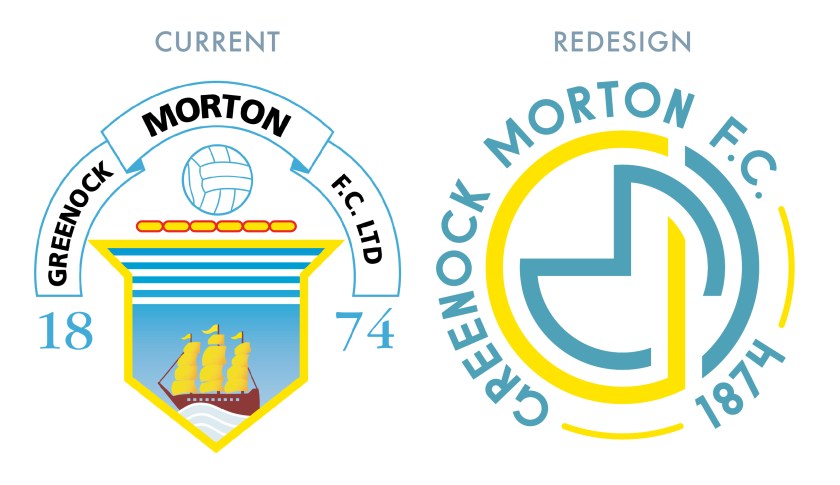
The current badge, derived from the Greenock coat of arms, is strong and some variation of it has been used since 1978. Before this, from 1964, a simpler badge, bearing the club’s name and three stars, was used on occasion.
In reworking such a strong badge, I did not want to design something that would appear too similar to other badges. I considered the other clubs which feature a ship in full sail on their badge: Stranraer, formed in 1870 and one of the oldest clubs in Scotland, and Clyde, formed in 1877. The ship on Stranraer’s badge was adopted in 1961, while the ship on Clyde’s badge, from what I can tell, came into being in the mid-1930s. If I wanted to defer either to the age of the club or longevity of the use of a ship in a club’s badge, Stranraer and Clyde, respectively, beat out Morton. The shipbuilding industry is tied very closely to Clyde’s name and it is possible that the presence of a ship on their badge predates the next earliest badge design by more than two decades, so I have gone with a ship in that redesign. It is possible that I have overthought this.
For Morton, I considered using the Free French Memorial on Lyle Hill in Greenock (which honours the fallen sailors of Free French Naval Forces who were based at Greenock from 1940 to 1945), or the James Watt Dock Crane (named after the 19th-century Greenock-born inventor). Ultimately, I departed from local symbolism entirely and adopted the main colours of the current Morton badge to form a modern ‘GM’ monogram (round so as to suggest a football).
For the home shirt, I went with the traditional blue and white hoops, which have featured on the vast majority of Morton’s home shirts from their earliest days (an aborted departure from which caused great unrest among Morton supporters in 2016). For the away shirt, the body is yellow (used commonly among many Morton away strips), with a seafoam green for the collar and sleeves.


As ever, I am indebted to Dave at Historical Football Kits for some of the historical information used above.
 Falkirk Football Club was established in 1876 and joined the Scottish Football Association two years later. During these early years, ‘the Bairns’ (a [primarily] eastern Scots word meaning ‘children’ and for natives of Falkirk, in general) competed in the early rounds of the Scottish Cup and played matches as part of the Stirlingshire Football Association.

 The history of association football in Scotland is tied inextricably to cricket. Along with clubs such as

 It is recorded that by the middle of the nineteenth century, nearly 20% of Dundee’s population were Irish-born immigrants. As
 Dumbarton Football Club was established in 1872, making it the fourth oldest association football club in Scotland, after


 The 2017/18 season was unpleasant for Brechin City Football Club. They finished at the bottom of the

 Dingwall-based Ross County Football Club were formed in 1929. Although the club was not admitted into the Scottish Football League until 1994, County has a long history of faring well against league sides in early rounds of the Scottish Cup while members of the Highland Football League. Since entering the SFL (and later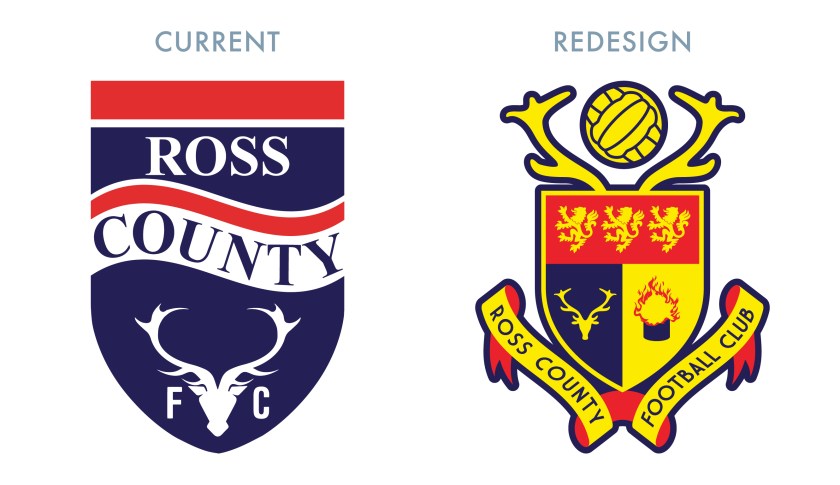


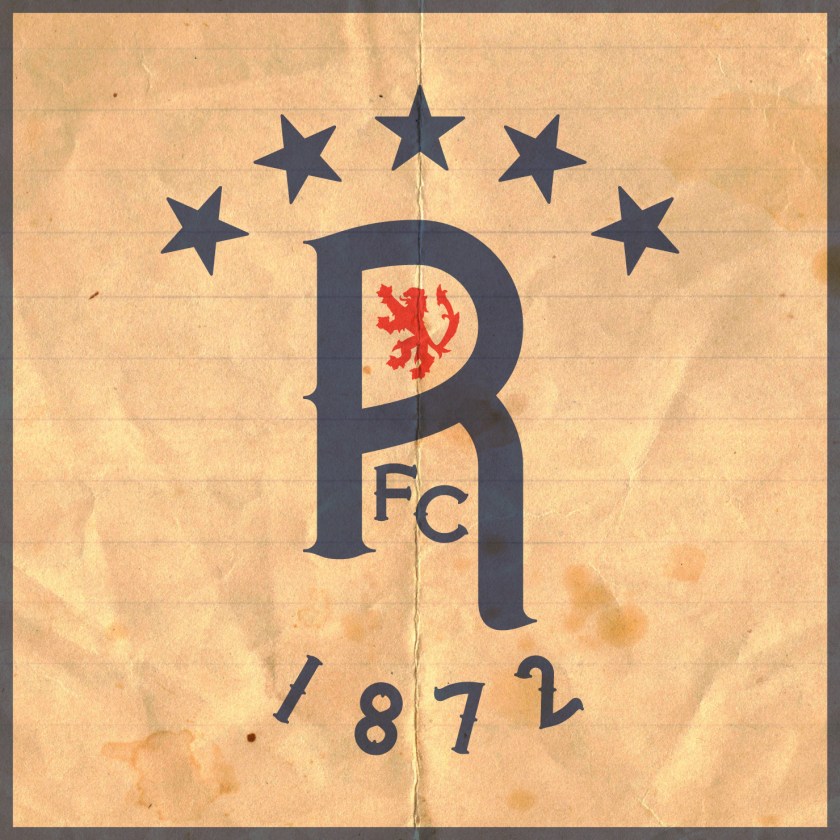
 In February 1872, brothers and avid rowers Moses and Peter McNeil met with fellow rowers Peter Campbell and William McBeath at Flesher’s Haugh (now part of Glasgow Green), on the northern bank of the River Clyde. It was not rowing that monopolised their attention that morning, but the spectacle of a group of men playing football on the green. Their imaginations were captured and they decided that they would turn their energies to organising their own football team.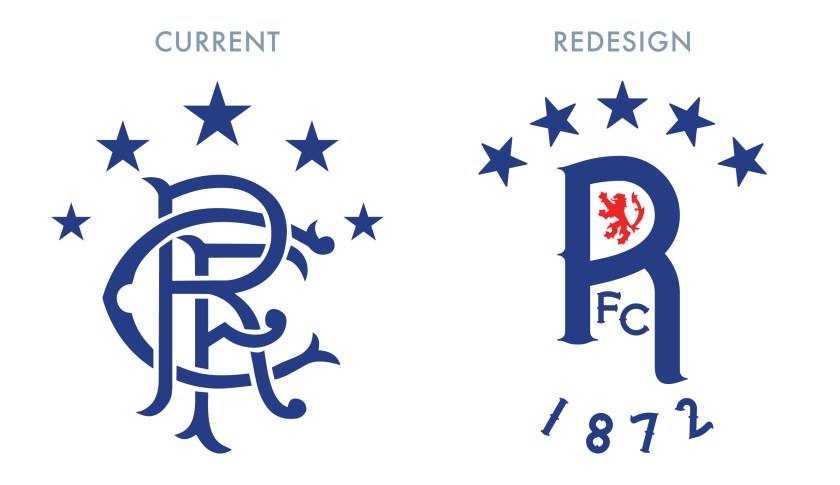

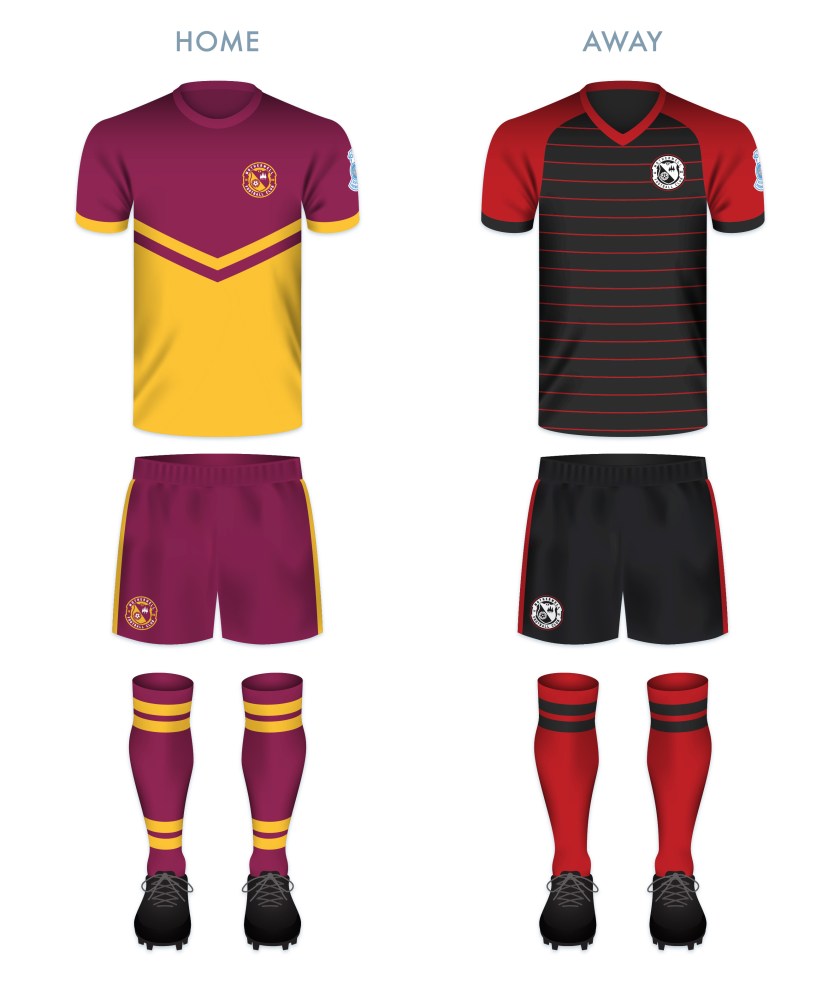
 Motherwell Football Club was established in 1886 at the merging of two Motherwell-based teams: Glencairn FC (established in 1877 and named after the soldier and politician John Glencairn Carter Hamilton, 1st Baron Hamilton of Dalzell) and Alpha FC (established as the Alpha Steam Crane and Engine Works team in 1881).

 Kilmarnock Football Club was formed in 1869, making it one of the oldest football clubs in the world. Before this time, Kilmarnock was an established cricket club, playing according to rugby football code in the cricket off-season. This rugby football code history is reflected in the naming of the club’s ground, Rugby Park.
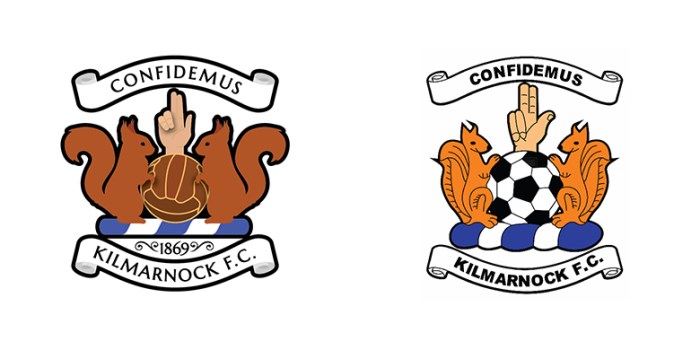 I was never quite satisfied with the redesign above. I have long appreciated the content of the current Kilmarnock badge, but have found the execution to be lacking. Ultimately, with my redesign here, I decided to go for something far more minimalistic, calling back to the original badge used from 1873 to 1887.


 ellliottt